|
|
|
|

Backup and
Restore Practices for Sun Enterprise Servers
Download
PDF of BookBackup & Restore Practices for Sun
Enterprise™ Servers is a practical guide for IT organizations that are tasked with
implementing or revamping a backup/restore architecture. The book includes case studies, a
methodology, and example runbooks. It addresses issues such as scalability and performance
of the backup/restore architecture, criteria for selecting tools and technologies, and
tradeoffs that must be considered. It provides technical guidelines for planning the
architecture to meet service levels, as well as general advice and guidance.

|
Boot Disk Management:
A Guide for the Solaris™ Operating System
Download
PDF of BookThis new book examines the life cycle of the Solaris Operating
Environment (OE) and its boot disk. Recomendations and methods for selecting hardware and partitioning the
Solaris OE boot disk are presented in detail. Additionally, this book provides recommendations for installing
the Solaris OE, as well as recommendations for managing Solaris OE upgrades with Live Upgrade.
|
Capacity Planning for Internet Services
Download PDF of Book
Capacity planning is a well known discipline, particularly for sites that have
a mainframe oriented background. The explosive growth of Internet sites and E-commerce has presented
new challenges in managing performance and capacity. In many cases, time constraints and business
demands can prevent normal capacity planning techniques from being applied. Classic datacenter capacity
planning methods can be adjusted, and successfully applied to this new Internet-centric computing environment.
This BluePrint charts a course through the available techniques and tools, examines timescales
and return on investment for different methodologies, and provides a framework for decomposing
big problems into solvable subproblems.
|
Designing Enterprise Solutions with Sun Cluster 3.0
Download PDF of Book
This new book is an introduction to architecting highly available systems with Sun servers, storage, and the Sun Cluster 3.0 software.
Three recurring themes are used throughout the book: failures, synchronization, and arbitration. These themes occur throughout all levels of systems design.
The first chapter deals with understanding these relationships and recognizing failure modes associated with synchronization and arbitration.
The second and third chapters review the building blocks and describe the Sun Cluster 3.0 software environment in detail.
|
Designing ISP Architectures
Download
PDF of BookThis book is a model for designing architectures for ISPs of any size. Expressly
for IT architects and consultants who design ISP architectures, this book
details the design process from start to finish. Throughout this book, whether
it's obtaining and evaluating requirements or creating logical and physical
designs, we provide helpful tips, insights, and expertise. We compare design
approaches, offer suggestions for evaluating trade-offs, and alert you to common
pitfalls.
|
Enterprise Data Center Design and Methodology
Download PDF of Book
This Sun BluePrint is a practical guide to designing a data center from inception through construction.
The fundamental design principles take a simple, flexible, and modular approach based on accurate, real-world requirements
and capacities. This approach contradicts the conventional (but totally inadequate) method of using square footage to
determine basic capacities like power and cooling requirements.
|
Enterprise Security: Solaris™ Operating Environment Security Journal, Solaris OE v2.5.1, 2.6, 7, and 8
Download PDF of Book
This guide provides the reader with best practices from Sun Microsystems for architecting multi-tiered
datacenter environments. It features documented, automated, and supported security best practices for
high-end servers and cluster software. Written for experienced developers and system administrators, it
includes tricks, tools, and techniques that hackers use to break into systems, The author details best
practices and tools for sniffing out "trojaned" system files and binaries and describes Solaris OE security
features, network settings, and minimization.
|
JumpStart™ Technology: Effective Use in the Solaris™ Operating Environment
Download PDF of Book
This Sun BluePrints book provides techniques on using the JumpStart™ technology for automated,
standardized, and secure installations of the Solaris™ Operating Environment. In addition, detailed examples of
using the JumpStart technology effectively on a day-to-day basis are provided in combination with never before documented
features and functions. The materials on the included CD contain the Solaris™ Security Toolkit (formerly known as "JASS")
and examples referenced in the book.
|
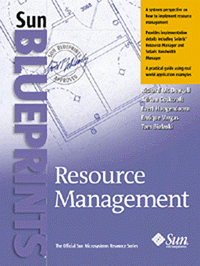
Resource
Management
Download
PDF of Book Ten years ago, the computing power of a
single Unix system barely met the requirements of a typical application. This created a
trend to use a large number of smaller systems, each running their own discrete
application. Each system managed its own resources for its application. Today, however,
the typical server is many times larger, so we often encourage running multiple
applications on each system. Unix is a timeshare operating system and attempts to
distribute the resources it manages among the applications which it hosts. However, the
distribution of these resources does not always align with the requirements of a given
application. This often means that required service and performance levels are not met due
to conflicting requirements for the same resources.
Resource Management is about managing system resources to optimize
service and performance levels, using methodologies that MVS Mainframe administrators are
familiar with. By using policies and resource management facilities, we are able to
provide control over how resources are allocated to applications.
The Resource Management BluePrint provides an introduction to resource
management principles and in depth details on implementating resource management in the
Solaris environment. It covers the various tools and techniques that facilitate resource
management, as well as how they should be implemented to allow system managers to meet
their service level and application performance targets.
Specifically, the Resource Management BluePrint covers:
- Introduction to resource management methodology
- Analysis and application of resource management to workloads
- Measurement and monitoring in a resource managed environment
- Policies for resource management and Sun Microsystems products for Resource Management
- Base Solaris and processor sets
- Solaris Resource Manager
- E10000 system domains and dynamic reconfiguration
- Network Resource Management
- Network batch job management with LSF
- Symon
- Resource management on clusters
|
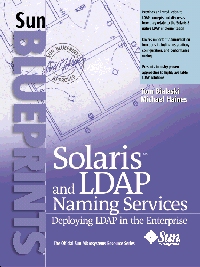
Solaris and LDAP Naming Services
Download
PDF of BookSolaris and LDAP Naming Services is a practical guide to implementing Solaris 8 native LDAP on clients and servers. Basic LDAP concepts are covered, as well as naming and authentication architectural details. This BluePrint outlines strategies for consolidating legacy directory services using LDAP technology.
|
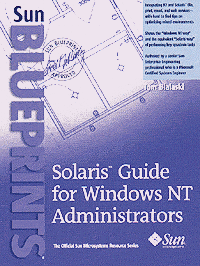
Solaris Guide
for Windows NT Administrators
Download
PDF of Book Just a few years ago, personal
computers (PCs) were networked together in their own little islands using network services
such as NetWare and LAN Manager to share printers and files. As these islands grew in
size, administrators were appointed to take care of them. At the time, these
administrators only needed to be concerned with the PC network protocols being used within
their departments.
With the introduction of Windows NT, a new class of PC servers began to
emerge. Instead of just providing file and print services, other services such as email
and database applications were provided on PC servers running the Windows NT operating
system. PC servers were no longer separate islands and began making their way into the
datacenter.
Unix servers, on the other hand, grew up in the datacenter as many
mainframe functions were offloaded to UNIX servers. These UNIX servers were administered
by trained UNIX administrators who had little contact with PC server administrators.
The arrival of PC servers in the datacenter heralded the arrival of the
PC server administrators. Since maintaining two different system administration
organizations is expensive, the trend in IT departments is to cross-train the staff. This
may seem like a formidable task. However, with a little guidance, experienced PC server
administrators can leverage what they know about Windows NT.
Specifically, the Solaris Guide for Windows NT Administrators BluePrint
covers:
- Understanding Solaris User Account Management
- Service and Task Management
- TCP/IP Administration
- File Sharing Administration
- Printer Administration
- Email Administration
- Web Services Administration
|
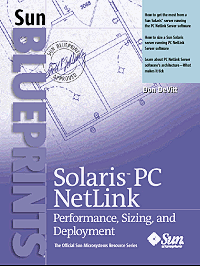
Solaris PC
Netlink
Download
PDF of Book The Solaris ™ PC NetLink Blueprint
is quickly becoming the bible by which system administrators and system planners are
obtaining the vital information they need to plan and implement an enterprise-capable PC
NetLink Software system.
Solaris PC NetLink Software is the latest offering from Sun to enable Sun servers to
support PC Client services. Solaris servers, with PC NetLink Software installed, not only
support both the file and print services that are common to all Microsoft PC operating
systems, but also allow Sun Workgroup and Enterprise servers to be fully integrated into
NT Domains as a Primary, or Backup Domain Controller (PDC, BDC). In addition, PC NetLink
Software offers the benefit of allowing NT system administrators to manage PC NetLink
Software systems using the same tools they already use to set up and maintain NT servers.
The purpose of this book is to supply system planners and system administrators the
information that allows them to install, tune and use their PC NetLink Software to its
maximum functionality and performance. Server sizing information is supplied for system
planners to scale their PC NetLink Software to their own PC Client environment.
|
Sun Cluster Environment: Sun Cluster 2.2
Download
PDF of BookThe explosive expansion of e-commerce and the ever-increasing dependency on computer services have created a global demand for server availability. This Sun BluePrints publication describes elements that affect availability and introduces best practices that promote good work practices. The information contained in this publication helps increase availability at the datacenter level or at the single-server level. The Sun Cluster 2.2 technology is explained in detail-the architecture, applications (including databases), low-end NFS servers, as well as maintenance requirements. This information can help customers apply specific product solutions to satisfy the most stringent high-availability requirements.
|
Techniques for Optimizing Applications: High Performance Computing
Download
PDF of Book This BluePrint is a practical guide to performance optimization of computationally intensive
programs on Sun UltraSPARC™ platforms. It is primarily intended for developers of technical or high performance computing (HPC) applications
for the Solaris™ operating environment. This audience includes both independent software vendor (ISV) developers and noncommercial developers.
It can also be used by end-users of HPC applications to help them better understand how applications utilize system resources.
The book presents information so that it follows logical stages of the process for application development and optimization. Authors Garg and
Shapov pay special attention to issues related to parallel applications and to using appropriate performance measurement tools. Wherever applicable,
sections are illustrated with code examples that show benefits of methods described.
Unless otherwise noted, topics in this book are not limited to a particular programming language, parallelization method, software version, or hardware product.
However, emphasis is on techniques relevant to applications written in Fortran 77, Fortran 90, and C, because these languages are most commonly used in HPC and
technical applications. Most topics can be applied to C++ programs; however, the authors do not address performance optimization issues specific to object-oriented programming.
|
|
|
|